
- Paws
The Guest Who Never Needs a Reservation
The Guest Who Never Needs a Reservation
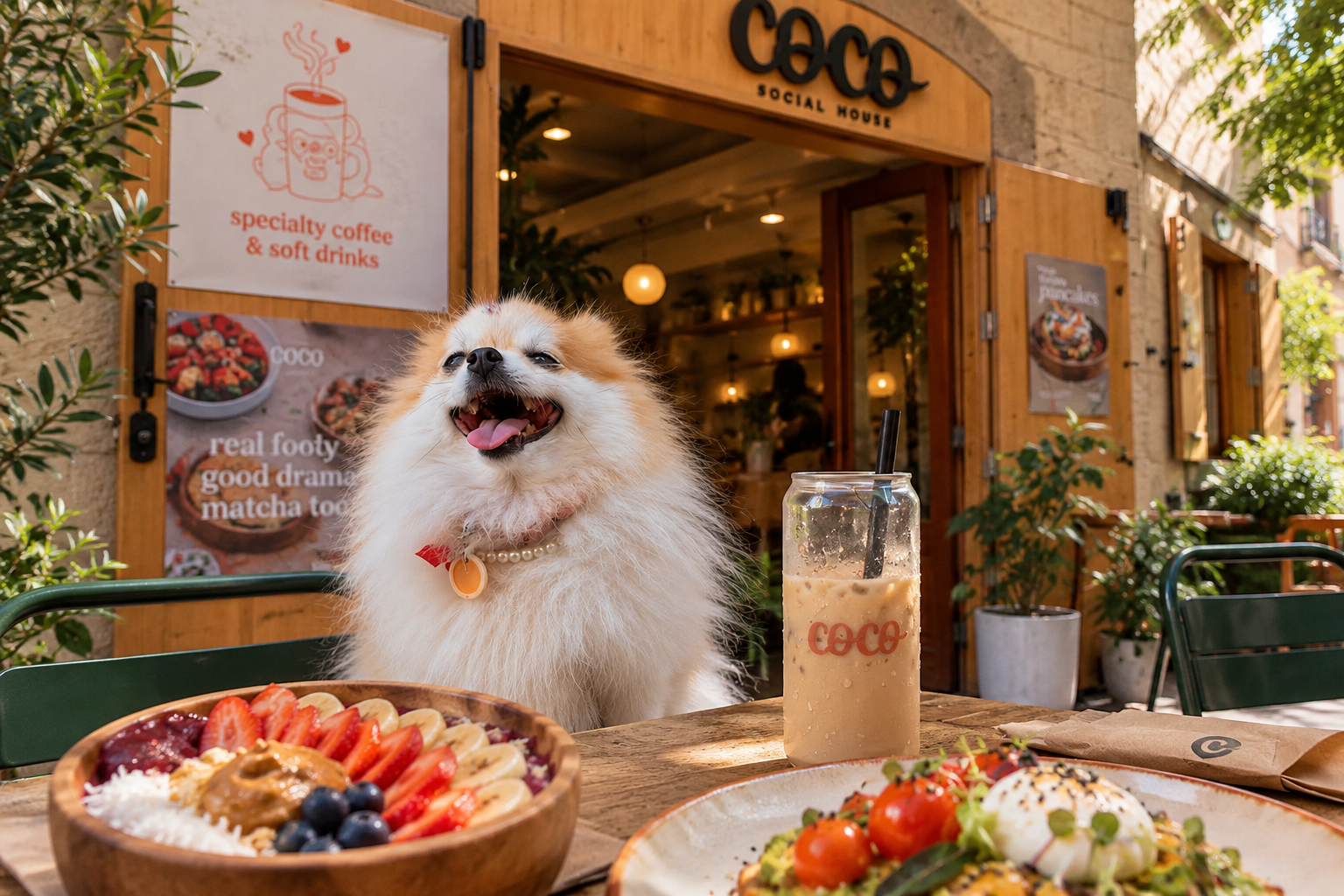
Every table at Coco Social House gets seated the same way. No waitlist, no special request, no explanation required, whether the guest walks in on two legs or four.
The brand says as much itself, plainly, without fanfare: matcha made for humans and dogs. It's a short line, but it's doing real work. Most cafés that welcome dogs treat it as a favor, something granted quietly, on a case-by-case basis, a nod from a server, an unspoken understanding that today happens to be fine. Coco Social House skips that negotiation entirely. There was never a rule to bend, because the welcome was never conditional in the first place.
What Gets Assumed, Not Asked
There's a meaningful difference between a place that tolerates something and a place that's built around it from the start. The first requires permission. The second requires nothing at all. Guests here don't have to check whether dogs are allowed, don't have to apologize for bringing one, don't have to catch a server's eye and hope for a nod before sitting down. The answer was already yes before the question got asked.
That distinction sounds small until you consider how rarely it actually holds true elsewhere. Plenty of places will allow a dog if pressed, but the framing still puts the guest in the position of asking for something extra, something outside the default experience. Here, there's no default experience to deviate from.
A City That Made This Easier
None of this happens in isolation. Barcelona has built a genuine reputation as one of the more dog-friendly cities in Spain, and Gràcia specifically gets singled out, more than once, as a neighborhood where having a coffee alongside a dog is simply part of the everyday rhythm, not a novelty. Several independent guides exist purely to help people find pet-friendly cafés and restaurants across the city, evidence that this isn't a fringe preference but an established part of how the city eats and drinks.
That context matters. Coco Social House isn't inventing a dog-friendly culture from nothing, it's operating inside one that already exists, and choosing to lean into it fully rather than half-heartedly. The brand's own stance reads less like a novel idea and more like a natural extension of a neighborhood that already thinks this way, just stated more plainly than most places bother to.
The Same Philosophy, Wearing a Different Coat
Coco Social House built its whole identity around slowing down, giving people a reason to stop rushing even briefly, to let a coffee stretch a little longer than it strictly needs to. That idea was never meant to apply narrowly, to only the people who arrive exactly as expected.
A morning that includes a dog is still a morning worth protecting from the rush, arguably more so, since a walk already asks someone to move at a slower pace before they've even sat down. The instinct that built this brand, disconnect from the noise, take your time, feel genuinely welcomed, doesn't have a clause that excludes anyone willing to slow down alongside everyone else.
Extending that same unhurried welcome to a four-legged guest isn't a separate initiative bolted onto the brand after the fact. It's the same instinct, applied consistently rather than selectively, which is really the only way an instinct like that means anything at all.
Why the Small Things Add Up
None of this gets announced with a banner or a special promotion. It shows up in something quieter and more durable instead: a policy nobody has to explain, because it was never treated as a policy to begin with, just an ordinary assumption about who gets to belong somewhere, in a city that already agrees.
The best version of hospitality doesn't measure who deserves an exception. It just decides, early and permanently, that there isn't one to make.